4th Grade Teacher Back to School Graphics & T-Shirt Designs
As a digital product creator who’s launched over 200 design assets across Etsy, Creative Market, and Printful stores, I opened 4th Grade-teacher Back to School Design with one question: “Can this go straight into my August launch without rework?” The answer—after testing it across six product formats—is yes, with smart adjustments.
The first impression is clean, confident, and classroom-ready. It strikes a balanced tone: friendly but not childish, professional but not stiff. Think crisp lines, intentional spacing, and a warm color palette that leans into teal, mustard, and soft navy—not primary reds or cartoonish pinks. It reads as teacher-approved, not just student-themed. That nuance matters. Buyers searching for “4th grade teacher gifts” or “back to school merch for educators” respond better to designs that signal authority and warmth in equal measure.
This graphic design asset works especially well for sellers targeting educators who value both personality and polish—think Etsy shops selling teacher appreciation bundles, Canva template sellers building editable lesson-planner kits, or print-on-demand brands curating seasonal apparel collections. Its visual personality sits comfortably between modern minimalism and approachable illustration—no clipart clutter, no overwhelming detail, and zero dated trends like chalkboard textures or overused apples.
I tested 4th Grade-teacher Back to School Design across real-world use cases:
- SVG products: Clean cut lines, no stray anchor points—ideal for Cricut users making vinyl decals for mugs or tote bags.
- PNG design files: Crisp 300 DPI transparency; holds up well on light and dark apparel mockups.
- Sublimation designs: Works on ceramic tumblers and polyester fabric—no banding or gradient issues at standard print sizes.
- Printable wall art & planner stickers: Scales beautifully down to 4×6” prints and 1.5” die-cut stickers.
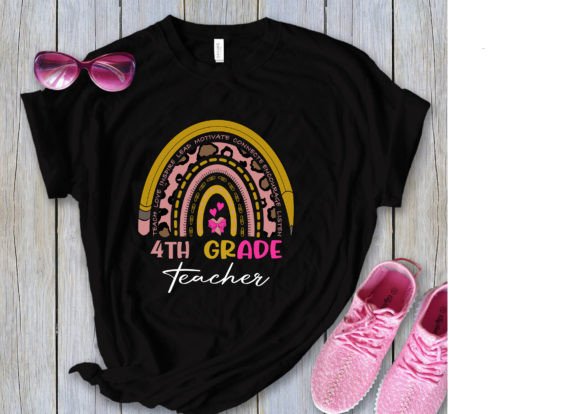
- T-shirt graphics: Optimized for screen printing and direct-to-garment—no thin strokes that vanish at small sizes.
- Canva templates: Easily layered over editable text boxes; pairs naturally with Montserrat (sans serif), Playfair Display (serif), and Quicksand (friendly display).
Where this asset shines most is in product presentation. I dropped it into three different mockup scenes—a relaxed teacher holding coffee, a tidy desk setup with supplies, and a vibrant classroom bulletin board—and each time, the design anchored the visual hierarchy without competing. That’s rare. Too many back-to-school graphics overwhelm thumbnails or fade in listing previews. This one pops at 200px width, supports consistent branding across a seasonal collection, and builds customer trust through its polished execution.
It fits seamlessly into themed bundles: combine it with editable lesson plan calendars, printable behavior charts, or “I ❤️ My 4th Graders” SVG mug wraps. For digital download shops, pairing it with matching social media graphics (Instagram story templates, Pinterest quote cards) increases average order value. And because it’s fully vector-based and color-editable, you can create variant listings—“teal version,” “rust version,” “black-and-white outline”—without generating new files from scratch.
That said, there are places to proceed with care. Avoid using it for tiny sticker sheets under 1” unless you simplify the inner details first—the fine line work around the pencil icon and book elements doesn’t always translate cleanly at micro scale. Also, test it against dark backgrounds early: while the default palette has strong contrast, swapping in a deep plum or charcoal may require a white stroke or subtle drop shadow for legibility. If you’re bundling it into a Cricut project kit, verify cut quality on your machine—some versions of the font-based text need manual outline conversion before cutting.
Before publishing any listing, run these five practical checks:
- Preview the PNG on both white and black t-shirt mockups—does the message stay clear?
- Open the vector file in Illustrator or Affinity Designer—confirm all layers are labeled and grouped logically (e.g., “main icon,” “text block,” “accent elements”).
- Export an SVG and import it into Cricut Design Space—check for hidden layers or compound paths that could disrupt cutting.
- Test print a sample on your home printer—look for unintended halos, blurry edges, or misaligned colors.
- Review the commercial license: ensure it permits resale of physical products (like printed tees or mugs) and digital derivatives (like Canva templates or social media kits).
For small business branding, this design asset supports consistency without limiting creativity. Use it as the hero graphic in your August email campaign, then echo its color scheme and typography in your shop banner, packaging inserts, and Instagram highlights. That kind of cohesion tells customers you’re intentional—not just uploading files, but building a brand.
One final note: don’t underestimate how much time this saves. The fact that it’s print-ready, fully organized, and built for both screen printing and digital printing means less prepping, fewer support questions from buyers, and faster turnaround on custom orders. As a handmade business owner or solo creative entrepreneur, that’s not just convenience—it’s margin.
If you're launching a back-to-school collection for Etsy, Shopify, or Creative Fabrica—or building a seasonal bundle for Canva template buyers—4th Grade-teacher Back to School Design delivers reliable versatility. It’s not flashy, but it’s functional. Not trendy, but timeless enough to sell beyond this August. And in digital product creation, that balance is where real revenue lives.